When a 4G LTE Failover Uplink Actually Pays for Itself in SMS
A 4G LTE failover uplink pays for itself when the send node sits outside a data center and a broadband outage would stall revenue-critical sends — stores, branch offices, and event venues. From redundant fiber with a large list, cloud API remains the more economical choice.
Your message queue sits on the same consumer-grade broadband as everything else in the building. When that link drops, messages queue client-side and never reach a carrier at all. A cellular modem gives them a second path over radio.
That is the entire pitch, and it is narrower than most hardware vendors imply.
If you send from a data center with redundant fiber, you will never trigger the redundancy you paid for. The hardware is dead weight from day one.
A failover uplink is a secondary network path — here a 4G LTE cellular modem — that takes over sends when the primary broadband link fails a health check.
The failure that hardware fixes, and the one it does not
Two different outages get conflated constantly, and only one of them is a hardware problem.
In a client-side outage your internet is down. Messages pile up in a local queue and never reach a carrier, so platform delivery reporting shows nothing whatsoever. In a carrier-side rejection your internet is fine and the carrier refuses the traffic — registration, content, reputation.
Cellular failover fixes the first. It does nothing for the second. Figure out which one you had before you buy anything.
Client-side queueing is the backlog of messages held on the sender’s own infrastructure before reaching any carrier, and it is invisible to platform-side delivery reporting.
Where send nodes sit outside a data center
Retail stores, branch offices, restaurants, event venues, and pop-up activations all originate messages from site hardware, and they share a structural weakness: the uplink is whatever broadband the landlord or the local ISP provides, and nobody in the marketing org has visibility into its reliability. That is the environment where a Thursday-evening outage converts directly into lost campaign revenue. It is also the environment where the loss is hardest to see, because the messages were never submitted, so no delivery dashboard ever records a failure — the campaign simply underperforms and the postmortem blames the creative. A cellular path removes the dependency entirely: the modem does not care whether the building’s fiber is up, because it never touched the building’s fiber. Whether that is worth $113 to $2,480 per site depends on how much revenue a stalled send window costs you, which is a number every multi-site operator can compute and almost none have. Work it out before the sales call rather than during it: take the revenue attributable to your last three timed campaigns, divide by the send window length, and you have a rough hourly figure per site for a stalled send. Compare that against the amortized hardware cost over thirty-six months and the decision usually makes itself, in one direction or the other, in about ten minutes. Sites where the answer is no should not get modems just because a pilot is running. Sites where the answer is yes will pay for the hardware in a single bad Thursday, which is the only ROI argument that has ever convinced a finance team.
What a failover config looks like
Reference values from a published North America modem SKU (WTI W4G-NAM-REM, verified 2026-10-14):
| Parameter | Reference value | Note |
|---|---|---|
| Modem category | LTE FDD Cat 4 | 150 Mbps down / 50 Mbps up |
| Primary interface | Wired broadband | eth0 |
| Cellular interface | LTE modem | wwan0 |
| Health check interval | 5 seconds | Determines detection latency |
| Failover threshold | 500 ms | Latency above which the link is considered failed |
| SIM failover order | ATT → TMUS → VZ | Confirm against your carrier contracts |
| SIM form factor | Standard SIM, 15 × 25 mm | 2FF |
| US bands | B2, B4, B5, B12, B13, B14, B66, B71 | Verify per SKU |
Comparison basis: one published North America modem SKU from a third-party vendor, used as a procurement baseline. Excludes service plan, installation labor, and taxes.
Air-interface disclosure. The table above is a third-party specification, not a Telarvo one. telarvostore.com never uses the term “4G LTE,” and publishes no band table for its modems or gateways — port count only. Get the air interface and band list in writing before you order.
A health check interval is the polling cadence at which the router tests the primary link, and its length is the maximum delay before failover traffic is released.
Multi-carrier SIM ordering and PLMN lock risk
Ordering SIM failover across carriers only works if the modem is not locked to a single network identifier. A PLMN lock that restricts registration to one carrier will make a multi-carrier SIM plan fail silently on the other two carriers.
When hardware is dead weight
Three profiles where a cloud API wins outright:
| Send profile | Better pick | Why |
|---|---|---|
| Data center, redundant fiber, 500K+ list broadcast | Cloud API | Redundancy already exists; modem adds cost without use |
| Long-tail, low-volume content sends | Cloud API | Hardware idle most of the month |
| High-volume tiered throughput, no site uplink risk | Cloud API or aggregator | Throughput is gated by campaign tier, not by uplink |
Comparison basis: US domestic A2P 10DLC, per-message economics over a 36-month horizon, excluding taxes. No vendor we checked publishes per-port throughput, so the hardware side assumes you measure it yourself.
The failure that is not bandwidth
Saturate one modem and two things climb together: latency and queue depth. The instinct is to buy more bandwidth.
The fix is a rate limiter at the dispatcher — fixed-window or token-bucket, keyed per modem, deferring excess sends to the next window. Bandwidth was never the constraint.
30-day pilot design
Start with your two worst sites — the ones with the ugliest broadband history. One modem each, SIMs from two different carriers.
Set the health check interval low enough that an outage is detected in seconds. Once a week, run one identical campaign down both paths.
Compare delivered counts and end-to-end latency. Not modem throughput, which tells you nothing about whether the failover actually fired when it needed to.
FAQ
Do I need cellular failover if I already have dual-WAN? Only if both WAN paths share a physical upstream. Dual-WAN on one fiber provider still fails together.
How fast should failover trigger to protect a flash sale? Detection within seconds. Set the health check interval low and the failover threshold tight, then measure actual failover latency in a pilot.
Can one modem carry SIMs from three US carriers? Yes if the SKU supports the relevant US bands and is not PLMN-locked. Confirm the band table in writing.
Will cellular failover help if the carrier rejects my messages? No. That is a registration, content, or reputation problem, and it needs a compliance fix rather than a hardware fix.
Is 5G required, or is LTE Cat 4 enough for SMS? LTE Cat 4 is sufficient for SMS. 5G matters for uplink throughput in dense venues, not for message delivery.
Sources
- WTI W4G-NAM-REM North America LTE modem specification — verified 2026-10-14
- iTechGuides — US carrier LTE bands — verified 2026-10-14
- Telarvo Store — SMS modem and gateway SKUs · About Telarvo — verified 2026-10-14
Blog
Learn more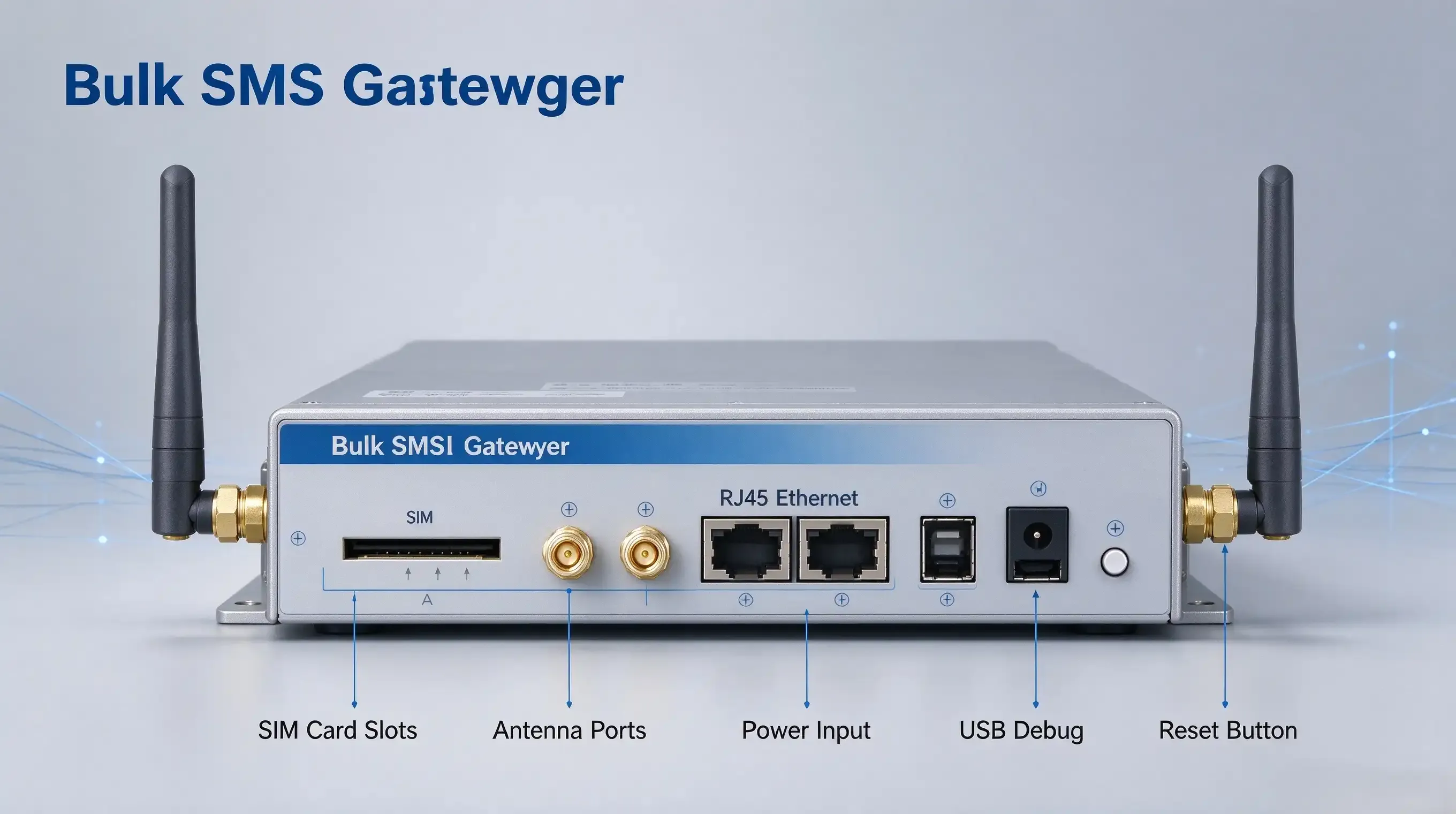
The 2026 SMS Compliance Checklist for US Marketing Managers
Federal floor plus state-level items to confirm with counsel: TCPA consent, 10DLC, RND scrubbing, recipient-local quiet hours. With sources and verified dates.
Bulk SMS for Marketing Managers: Cloud API vs SIM Modem Pool
Where the cloud-API-to-SIM-hardware crossover sits in 2026 — US 10DLC fees, carrier pass-through, and a break-even model.
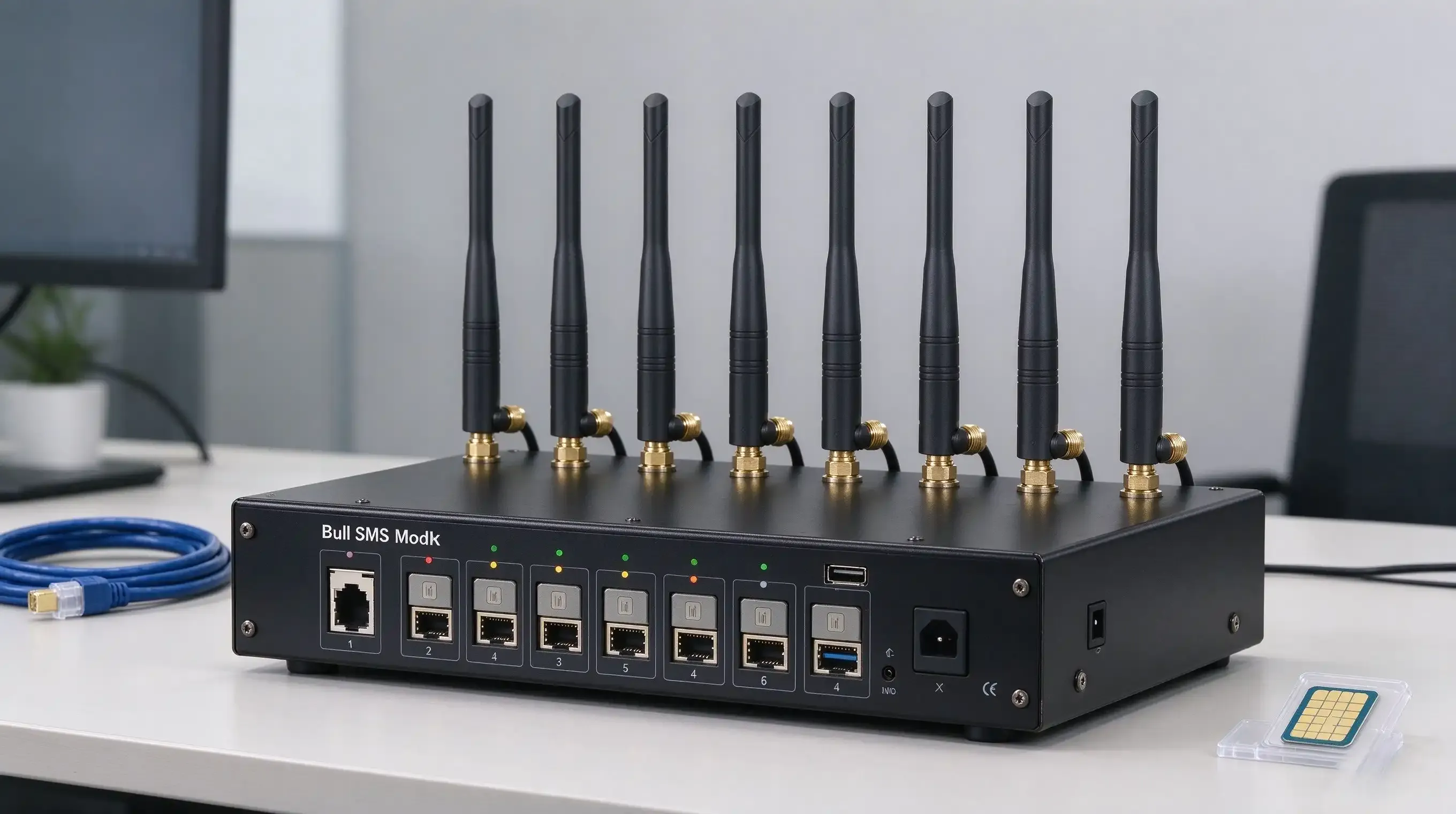
US LTE & 5G NR Bands for Bulk SMS Hardware: Why a "B1/B3" Spec Sheet Is a Red Flag
Only LTE-FDD B2 of the common B1/B2/B3 trio is in live US carrier use. US band matrix for SMS gateways, with 3GPP and carrier sources.