How SMS Gateways Multi-SIM Management Cuts Carrier Throttling Risk
Table of Contents
- The Core Value of Multi-SIM Management: Why Multiple Slots Matter
- SIM Rotation Strategy Configuration
- Load Balancing: Round-Robin Distribution
- Failover Protection
- Remote SIM Pool Integration
- Monitoring and Adjustment
- FAQ
When SMS volume grows from “a few messages occasionally” to “tens of thousands per day,” a single SIM card quickly hits carrier throttling. The core value of a multi-SIM gateway is its SMS Gateways Multi-SIM Management capability: distributing the sending source across a compliant number pool to reduce the probability of a single number triggering the carrier threshold.
The Core Value of Multi-SIM Management: Why Multiple Slots Matter
Carriers impose practical daily limits on individual numbers. For A2P 10DLC traffic in the U.S., T-Mobile’s daily cap varies by brand trust score: the lowest tier is 2,000 SMS segments per day, while the highest tier (trust score 75-100) can reach 200,000 segments. This data comes from the Surge Deliverability documentation and T-Mobile’s public 10DLC rules, valid as of 2026; refer to the carrier’s latest announcements. Without multi-card rotation, a single number’s usable volume quickly becomes a bottleneck as the business grows.
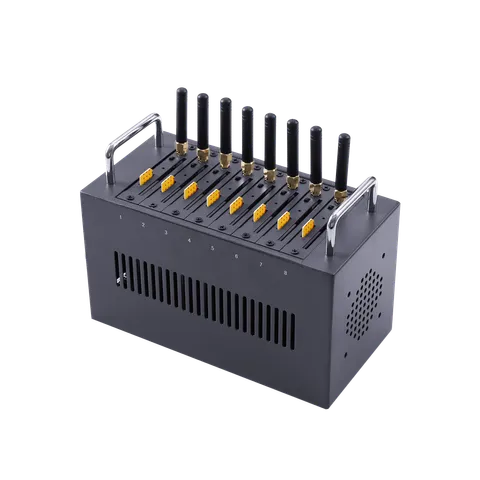
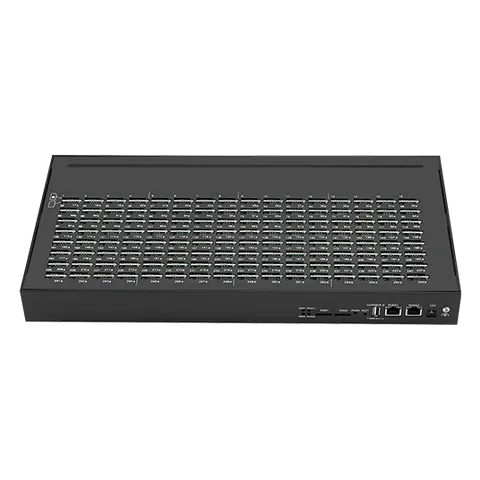
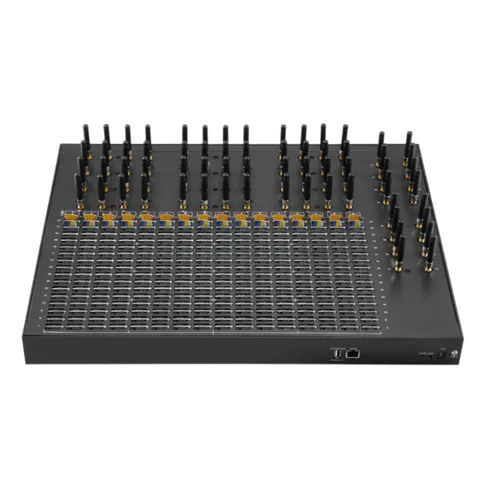
The Telarvo SK-SMS Gateway 16-256 provides 256 SIM slots, so a single device can build a number pool and spread sending pressure across hundreds of numbers.
SIM Rotation Strategy Configuration
In the web management panel, go to the SIM management module to configure rotation by send volume or time interval. The device panel typically shows one of the following states for each card: in use, queued for rotation, no card, or disabled. If a card stays in “queued” for a long time, the rotation rule is too aggressive or the card has been flagged as abnormal by the system.
Our recommendation: when daily volume exceeds 5,000 messages, set the per-card daily cap to 200 and the rotation interval to no more than 30 minutes. This is not a hard carrier rule but a conservative judgment based on “a single card’s sending frequency should not look like a burst.”
Load Balancing: Round-Robin Distribution
For bulk campaigns, enable round-robin: the system assigns each outgoing SMS to the next available SIM card in turn. Round-robin keeps the number pool’s volume balanced and prevents individual cards from hitting the carrier’s daily cap too early.
Note: if the pool mixes SIM cards from different carriers, pure round-robin may send a target number on Carrier A from a Carrier B card, reducing efficiency. A better approach is to filter available cards by carrier first, then rotate among cards of the same carrier.
Failover Protection
The gateway supports SIM-level failover. When a card is unregistered, out of balance, or has a network anomaly, pending tasks can automatically transfer to other available SIM cards. We recommend enabling “auto-disable abnormal SIM” and setting up alerts.
Remote SIM Pool Integration
A remote SIM pool chassis supports up to 512 SIM cards and shares number resources with multiple gateways over the network. One customer placed one SK-SMS Gateway 16-256 in each of three data centers in Jakarta and centrally managed 256 cards through a remote SIM pool. Local operations in Jakarta only needed to swap cards at the SIM pool end—the panel configurations on the three gateways did not need to be adjusted one by one.
Monitoring and Adjustment
Review each SIM card’s send volume, delivery rate, and failure reason distribution weekly, and retire cards with persistently low delivery rates. Multi-SIM management is not a one-and-done configuration.
| Management Function | Use Case |
|---|---|
| SIM rotation (by volume / by time) | Bulk campaigns, even distribution |
| Load balancing (round-robin) | High-volume concurrent tasks |
| Failover | High-availability requirements |
| Remote SIM pool invocation | Shared number pools across gateways |
FAQ
Q: Should I choose rotation by send volume or by time interval? For bulk campaigns with high short-term volume, choose by volume; for slower, all-day distribution, choose by time interval. The two can be combined.
Q: Will round-robin cause a card to be skipped? Not intentionally. Unavailable cards (unregistered, out of balance) are excluded—that’s failover at work.
Q: Does SIM failover need to be enabled manually? In testing, we found that “auto-disable abnormal SIM” is off by default in some firmware versions. Confirm this setting during configuration; if it’s off, a dead card won’t be removed from the pool automatically.
Q: Must the remote SIM pool be the same brand as the gateway? Not necessarily, but compatibility depends on whether the gateway supports that SIM pool’s remote invocation protocol. Confirm protocol-level interoperability before mixing.
Q: How often should I review monitoring data? Weekly is recommended. Review more frequently during high volume or right after go-live.
Sources:
- Surge Deliverability (T-Mobile daily segment cap reference)
- Aircall 10DLC trust score and T-Mobile daily limit comparison
- Telarvo SK-SMS Gateway 16-256 specifications
Compliance note: The T-Mobile daily caps and 10DLC trust score data in this article are time-sensitive; refer to the carrier’s current announcements in the target country as the final authority. The multi-SIM scheduling capabilities described here are intended solely for registered, user-consented compliant SMS traffic. Any use aimed at circumventing carrier risk controls through distributed sending is outside the scope of this article and is not supported.
Blog
Learn more
Enterprise VoIP Gateway Security Hardening: Toll Fraud Prevention Strategies Through the VOIP Gateway
A VoIP gateway for regulated industry needs defense in depth: IP ACLs, strong SIP auth, voice VLAN isolation, and ASR/ACD anomaly alerts to stop toll fraud.
VoIP Gateway Deployment Checklist: 15 Compliance and Security Checks
Before deploying a VoIP gateway, run these 15 checks: power and cooling, VLAN isolation, SIP IP whitelisting, SIM real-name compliance, and security hardening.
How the VOIP Gateway 32-512 Update Improves ROI with a 512 SIM Pool
The VOIP Gateway 32-512 update adds a 512 SIM pool, custom rotation triggers, and carrier-weighted scheduling—cutting call center line costs by about 30%.