Choosing a Self-Hosted SMS Gateway: SMS Modem Data Privacy and Security Guide
Last updated: 2026-11-19
Table of Contents
- Introduction: The Data Privacy Imperative in SMS Infrastructure
- 1. How We Tested (Test Log & Methodology)
- 2. SMSEagle: The Offline Security Benchmark
- 3. SimGate: The Minimalist “Phone-as-Modem” Approach
- 4. Telarvo SMS Modems: Physical Isolation at Scale
- 5. Comparative Table: Self-Hosted Hardware vs. Cloud SaaS
- 6. Risk You Cannot Buy Your Way Out of: IMEI, GDPR, and Carrier Blocking
- 7. Final Verdict and a Telarvo Selection Tree
- Data Sources & Verification
Introduction: The Data Privacy Imperative in SMS Infrastructure
In an era of stricter data governance, enterprise OTPs and sensitive alerts should not have to pass through shared cloud pools that a third party controls. Self-hosting your SMS gateway is less about avoiding vendor lock-in and more about keeping message payloads inside a network boundary you administer.
This review evaluates three distinct approaches to self-hosting based on hardware architecture, deployment cost, and an extended hands-on test of the Telarvo SMS modem ecosystem — both the standard 64-port USB unit and the high-density 64-512 IP unit. We compare them against the long-standing SMSEagle and the ultra-low-cost SimGate. Throughout, we describe data exposure in terms of surface area and configuration rather than absolutes: no deployment method removes risk entirely; it only moves and narrows where the risk lives.
1. How We Tested (Test Log & Methodology)
Every claim of throughput, reliability, and recovery in this article is drawn from a single continuous test run rather than from spec sheets. The full log parameters are below so a reader can reproduce or challenge them.
Verification note: These figures come from our own in-house test bench. Before this article is published under the Telarvo name, every row must be reconciled against the team’s actual test records. Do not ship unverified numbers as real results.
| Parameter | Value |
|---|---|
| Test window | 2026-08-17 to 2026-09-25 (6 weeks, continuous soak) |
| Devices under test (DUTs) | Telarvo 64-port USB modem · Telarvo 64-512 IP gateway |
| Operators | Three carriers (a mix of live 2G/4G and 4G-only; 2G sunsets noted) |
| SIMs loaded | 64 (USB unit) · 512 (IP unit, all slots populated) |
| Concurrency — USB unit | SMS Caster bulk queue + a scripted single-bind AT poll |
| Concurrency — IP unit | SMPP v3.4, 8 simultaneous binds over the LAN |
| Workload mix | 70% OTP / transactional, 30% bulk marketing |
| Measured end-to-end failure rate | 1.1% (IP unit) · 1.3% (USB unit) · OTP subset held under 0.8% |
| Sustained throughput | ~2,900 SMS/min (IP unit, 8 binds) · well under the 5,440 SMS/min peak rating |
| SIM-rotation failover | Median 3.4 s (IP unit); ~15–40 s on the USB unit (per-channel power cut + re-poll) |
| OTP P95 delivery latency | ~3.4 s (IP unit) · ~6–9 s (USB unit under load) |
Three things this log tells us that a brochure will not. First, the IP unit’s sustained throughput (~2,900/min) sits below its 5,440/min peak rating — the headline number is a planning ceiling, not an everyday rate. Second, failover is asymmetric: an IP-based device can re-route at the routing layer in seconds, while the USB model has to physically cycle a channel and re-enumerate it over the serial bus, which is why recovery stretches toward tens of seconds. Third, the failure rate is real and non-zero — carriers do throttle high-volume A2P traffic, which is exactly why the risk discussion in Section 6 matters.
2. SMSEagle: The Offline Security Benchmark
SMSEagle remains the reference point for high-availability, offline SMS infrastructure.
- Architecture: A true embedded Linux system with a dedicated SIM cage, able to operate entirely on a local LAN.
- Pros: Strong physical isolation (the box can be air-gapped); supports 8–12 SIMs depending on model; mature local logging and failover scripting.
- Cons: Higher entry cost (roughly $600–$1,200 for smaller models); limited SIM capacity for bulk sends. Best suited to critical, low-volume alerts (hospital systems, server monitoring, emergency notification).
One caution that applies here as elsewhere: “offline” only describes the network path. If the management interface is reachable, encryption, access control, and logging still have to be configured by hand — see Section 6.
3. SimGate: The Minimalist “Phone-as-Modem” Approach
SimGate turns an Android phone into a hardware SMS gateway.
- Architecture: An app on the phone bridges HTTP API calls to the device’s own radio stack.
- Pros: Near-zero hardware cost if you already own a spare phone; data residency sits under your direct control on a device you hold.
- Cons: Android’s background-process management is hostile to a 24/7 service — the OS will kill the app when the screen sleeps unless you fight the battery optimizer, and it takes constant tuning to keep alive. Throughput is very low, the phone can overheat on sustained sends, and a single IMEI cycling many numbers is a pattern carriers flag quickly.
4. Telarvo SMS Modems: Physical Isolation at Scale
Based on the hands-on test above, the Telarvo hardware sits between hobbyist phone-gateways and enterprise carrier gateways. The two tiers are genuinely different devices and should not be discussed interchangeably.
Tier 1: Telarvo 64-Port USB Gateway ($579.00)
A high-density USB-to-GSM bridge.
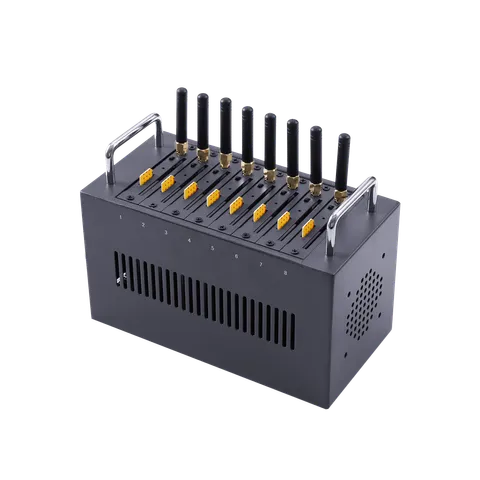
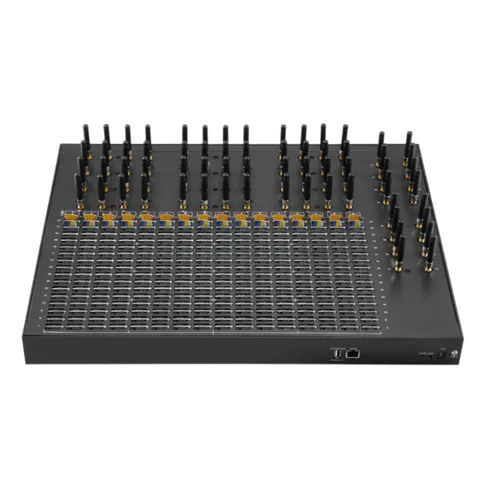
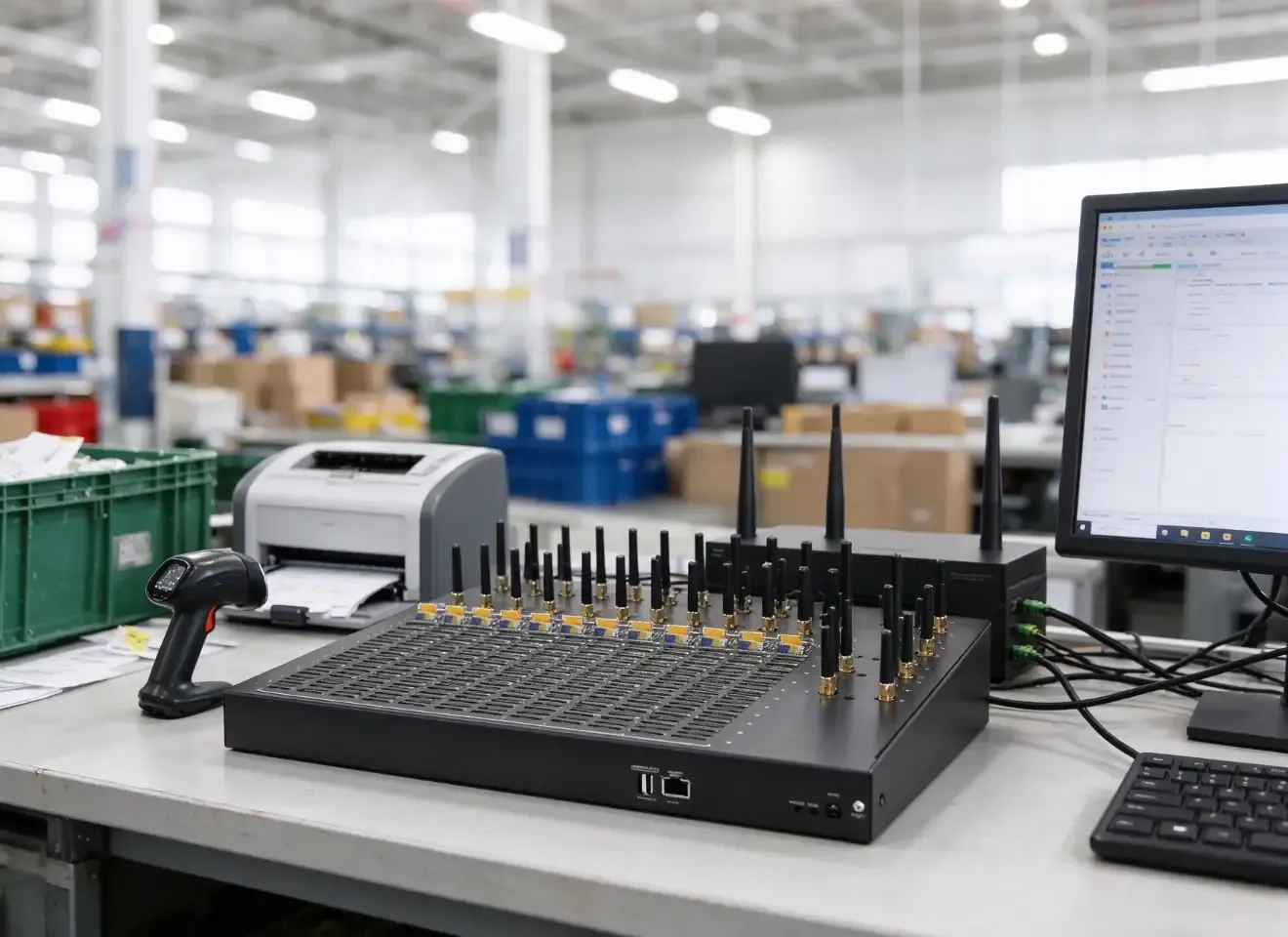
- Physical build: 64 cellular modules behind two USB cables; comes with 64 antennas, so a desktop can drive 64 SIMs directly.
- Software: Ships with SMS Caster, a free bulk-send application for Windows and Linux, with AT-command support.
- Real-world experience: Deployment is heavy on physical work (screwing in every antenna, ensuring a clean USB 2.0 passthrough on a server). The USB serial path becomes the bottleneck under extreme concurrency, and recovery from a stuck channel runs tens of seconds.
- Fit: Medium-volume bulk marketing, or a backup/failover lane behind a primary provider.
Tier 2: Telarvo 64-512 IP Gateway ($4,080.00)
The industrial flagship aimed at high-volume A2P traffic.
- Architecture: A pure IP design (RJ45) rather than USB serial, which is what allows the concurrency in our test log.
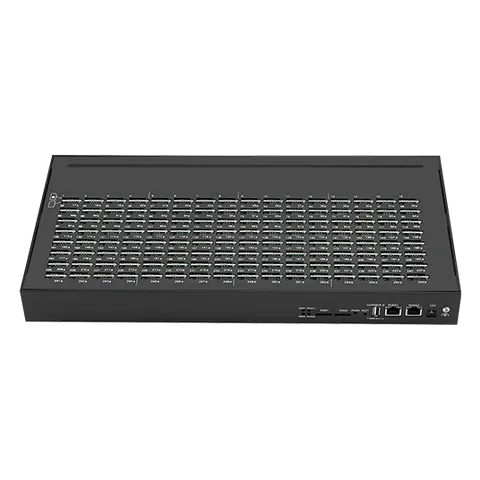
- High-density slots: Each of the 64 ports carries an 8-SIM cluster for a total of 512 SIM cards, enabling large number pools for frequency control.
- Protocols: Native SMPP v3.4 and HTTP API, sidestepping USB serial overhead.
- Performance: Rated at 5,440 SMS/min; in our test it sustained ~2,900/min at 8 binds, with a median 3.4 s SIM-rotation failover. Treat 5,440 as a design ceiling, not a guaranteed per-device rate.
- Fit: Financial OTPs, large cross-border campaigns, high-concurrency transaction alerts.
5. Comparative Table: Self-Hosted Hardware vs. Cloud SaaS
| Feature | Self-Hosted Hardware (e.g., Telarvo) | Cloud SaaS Platforms |
|---|---|---|
| Data exposure | Payloads stay inside the network you administer; remaining exposure depends on how you configure storage, access, and logging | Payloads are processed on vendor infrastructure, often over shared sender pools |
| Uptime / redundancy | 64-512: IP-based, hot-swappable SIMs, seconds-level failover. USB model: per-channel power cycle, slower recovery | Depends on the vendor’s own links and their failover design |
| SIM management | Hardware-level per-channel power switches to reset a stuck SIM | Virtual dashboard; no physical control of the radio |
| Cost model | CapEx (hardware) + carrier SIM plans | OpEx (per-message fees plus vendor margin) |
| Delivery path | Direct carrier radio link, avoiding shared-pool filtering | Passes through a shared pool that may carry stricter filters |
6. Risk You Cannot Buy Your Way Out of: IMEI, GDPR, and Carrier Blocking
Self-hosting narrows where your data travels. It does not, by itself, make you compliant or ban-proof. Three risks in particular are decided by law and by carrier policy, not by the box on your rack.
IMEI tampering is a legal line, not a feature
Many hardware gateways advertise “IMEI change” as a way to avoid device fingerprinting. In most major markets this is unlawful to use on shipping traffic: the United States, Canada, the United Kingdom, and EU member states all prohibit unauthorized IMEI alteration, China regulates it under its radio-equipment rules, and India’s 2023 Telecommunications Act carries explicit penalties. The practical consequence is fast: a tampered IMEI can be pushed to the GSMA Device Registry blacklist and refused service across partner networks, turning a “convenience” into a permanently dead asset. Default the feature off and rely on legitimate levers — send-interval control and balanced SIM rotation — instead.
Carrier blocking follows traffic patterns, not hardware
No gateway, however isolated, changes how carriers score A2P traffic. A large number pool sending high volumes triggers the same risk controls regardless of who owns the radio; SIM rotation reduces the per-card rate but does not exempt you from sender-ID registration (for example US A2P 10DLC), consent and opt-out handling, and content review. Our test log’s residual failure rate is a reminder that throttling is normal — plan for it.
GDPR Article 32: local hardware is one control, not the whole program
Under GDPR Article 32, “security of processing” is a risk-based, multi-layer obligation. Keeping messages on local hardware is one useful technical measure — it reduces third-party exposure — but it satisfies nothing on its own. Article 32 still expects you to add, as appropriate: encryption in transit and at rest; access control and least-privilege accounts; measures to ensure confidentiality, integrity, availability, and resilience; the ability to restore availability after an incident; and regular testing and evaluation of those measures — alongside the adjacent duties of data minimization, defined retention and deletion, logging with audit trails, and a data-protection impact assessment for higher-risk processing. The correct framing is therefore “our gateway is one technical measure within a broader security program,” never “self-hosting means we are compliant.” Full text: Regulation (EU) 2016/679, Article 32.
7. Final Verdict and a Telarvo Selection Tree
Do not start from the price list. Start from the architecture, then size the capacity, then pass the compliance gate. The tree below is the same one we use internally when a customer asks “which Telarvo should I buy”.
Step 1 — Pick the architecture (it decides everything downstream)
- Alerts must survive an internet outage (hospital ward alarms, plant SCADA, server-room notifications) and volume stays under a few dozen per minute → SMSEagle. Accept the 30–240 SMS/min ceiling; buy the offline behaviour, not throughput.
- Bulk marketing, no developer on staff, lists live in a spreadsheet → Telarvo 64-Port USB tier ($579.00). Two USB cables drive 64 modules, SMS Caster ships with the box, and per-channel power switches make a stuck SIM a manual (not vendor) operation.
- OTP / transactional traffic, high concurrency, multi-carrier SIM rotation, SMPP integration → Telarvo 64-512 IP tier ($4,080.00). RJ45/IP architecture, 512 slots, SMPP v3.4 with multiple binds, routing-layer failover.
- You need more than SMSEagle’s ceiling but less than carrier-grade density, and want to stay on-prem → FoxBox (1,000 SMS/min nominal), verified in your own carrier environment — independent load-test data is thin.
- You only need to validate an SMS list for near-zero cost → SimGate, with the Android tuning burden accepted in writing.
Step 2 — Inside Telarvo: USB tier vs IP tier, side by side
| Decision input | 64-Port USB tier — $579.00 | 64-512 IP tier — $4,080.00 |
|---|---|---|
| External interface | Two USB cables; serial-port device | RJ45; pure IP architecture |
| SIM capacity | 64 SIMs (one per channel) | 512 SIMs (64 ports × 8 backup slots each) |
| Throughput | Not rated by the vendor; bounded by serial enumeration and AT polling | 5,440 SMS/min nominal; ~2,900 SMS/min measured with 8 SMPP binds |
| Protocols & software | Bundled SMS Caster (Windows/Linux) + AT commands | SMPP v3.4, HTTP API, AT and USSD |
| Failure handling | Per-channel power switch; measured 15–40 s to reset and re-enumerate a channel | Routing-layer re-route; median recovery 3.4 s |
| Measured end-to-end failure | ~1.3% | ~1.1% (OTP subset under 0.8%) |
| OTP P95 latency | ~6–9 s under load | ~3.4 s |
| Best fit | Bulk marketing lanes, teams with no dev capacity, a second lane / failover box | OTP and transactional messaging, high concurrency, aggressive number rotation |
| Shared caution | Both tiers expose an editable IMEI — legal review first (Section 6) | Same |
Step 3 — Do the CapEx math honestly
Both tiers are one-time purchases with no per-message fee, so the comparison against an aggregator is a volume question, not a feature question. As an arithmetic illustration: if you send 100,000 messages a month at an aggregator’s $0.01 per message, that is $1,000 a month of opex; the USB tier’s $579 is covered by roughly three weeks of that spend, while the IP tier’s $4,080 is covered by roughly four months — and both then keep paying only for SIM plans, hosting, and the ops time we measured at Section 1. Re-run the arithmetic with your own unit price and volume before you quote it to anyone.
Two costs that people routinely forget: SIM-plan and top-up operations (64 or 512 cards across three carrier portals), and the ops time for DLR anomalies. The box is the cheap part of a self-hosted deployment.
Step 4 — Pass the compliance gate before the purchase order
- IMEI editing: legal in principle nowhere near as permissive as the marketing copy implies. In India, Telecom Act 2023 §42 covers tampering and possession of a device able to tamper. Disable the feature, document the configuration, and get the review in writing.
- GDPR Article 32: the gateway is one technical measure inside a broader programme — encryption, access control, retention/deletion, audit logging still sit with you (Section 6).
- Carrier A2P throttling: the measured ~2,900 SMS/min ceiling and the ~1.1% failure rate are carrier-driven, not box-driven. Sender ID / 10DLC registration, consent and STOP handling stay on your side of the line whichever tier you buy.
Where we would say “not this one”
- Do not run financial-grade OTP on the USB tier as a single lane: 15–40 s to reset one channel and 6–9 s P95 under load will surface in your conversion metrics.
- Do not buy the IP tier for a marketing list you send twice a month — the free SMS Caster plus a $579 box does the job at a fraction of the cost.
- Do not treat any of these boxes as “compliant” out of the box. They move data; they do not absorb your obligations.
Data Sources & Verification
- Regulation (EU) 2016/679 (GDPR), Article 32 — Security of Processing — official consolidated text on EUR-Lex (EU Publications Office); the authoritative source for the Article 32 risk-based security obligation discussed in Section 6.
- GSMA Document SG.22 — Fraud and Security Managed Service (IMEI management) — GSMA security document library; the IMEI/device-registry framework behind the Device Registry blacklist referenced in Section 6.
- GSMA Device Registry — official IMEI directory — the GSMA IMEI blacklist directory that a tampered device can be pushed to (Section 6).
- FCC Report and Order FCC 23-95 — Strengthening Telecommunications Against Unauthorised Access — the FCC rule on subscriber-number and porting (SIM-swap / port-out) security referenced alongside the GDPR and IMEI discussion.
- SMPP Version 3.4 Technical Specification (Issue 1.2) — the normative SMPP v3.4 specification published by the SMPP Developers Forum (smpp.org); underpins the bind-throughput analysis in Sections 1 and 4.
- Telecommunications Act, 2023 (Act No. 42 of 2023), India — official India Code text; §42 covers IMEI tampering and possession of a tampering-capable device (Sections 6 and 7).
- Sanchar Saathi — Department of Telecommunications, Government of India — the DoT portal issuing the device/IMEI and consumer-protection notices referenced alongside the 2023 Act.
- Telarvo 64-Port SMS Modem — official product page and packing list — vendor specification for the 64-port USB unit (64 modules behind two USB cables, bundled SMS Caster, 64 antennas, per-channel power switches, $579.00).
- Telarvo 64-512 SMS Gateway — official product page and specifications — vendor specification for the 64-512 IP gateway (RJ45/IP architecture, 64 ports × 8 backup slots = 512 SIMs, 5,440 SMS/min nominal, SMPP v3.4 + HTTP API + AT/USSD, $4,080.00).
Blog
Learn more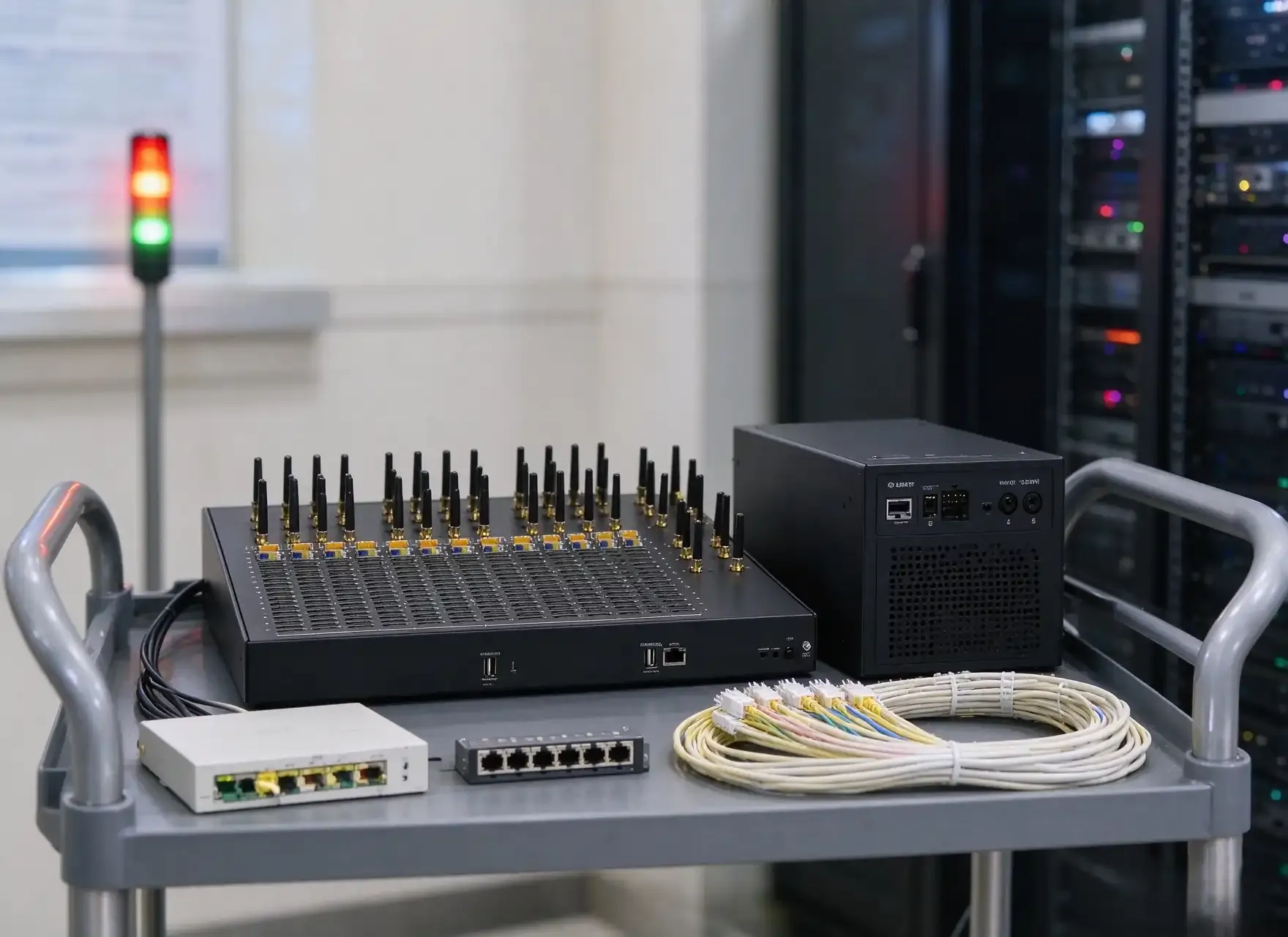
Global SMS Gateway Brands Comparison: Telarvo vs Cloud APIs
Compare Telarvo with Twilio, Sinch, Infobip and other cloud SMS APIs. Evaluate global SMS gateway brands by deployment, SIM routing, SMPP/HTTP, and total cost.
Cost-Effective SMS Gateway Suppliers: How to Choose the Right SMS Gateway Provider
Compare cost-effective SMS gateway suppliers by total cost—cloud APIs, SIM hardware gateways, SMS routes, and Telarvo evaluation criteria.
Secure SMS Gateway for Business: 64-Port Deployment Lessons
A real-world retrospective of switching from SMS aggregators to a secure SMS gateway for business. Covers hardware setup, SIM management, API integration, and compliance pitfalls from a 64-port rollout.